
Footballer Rupak Chowdhury
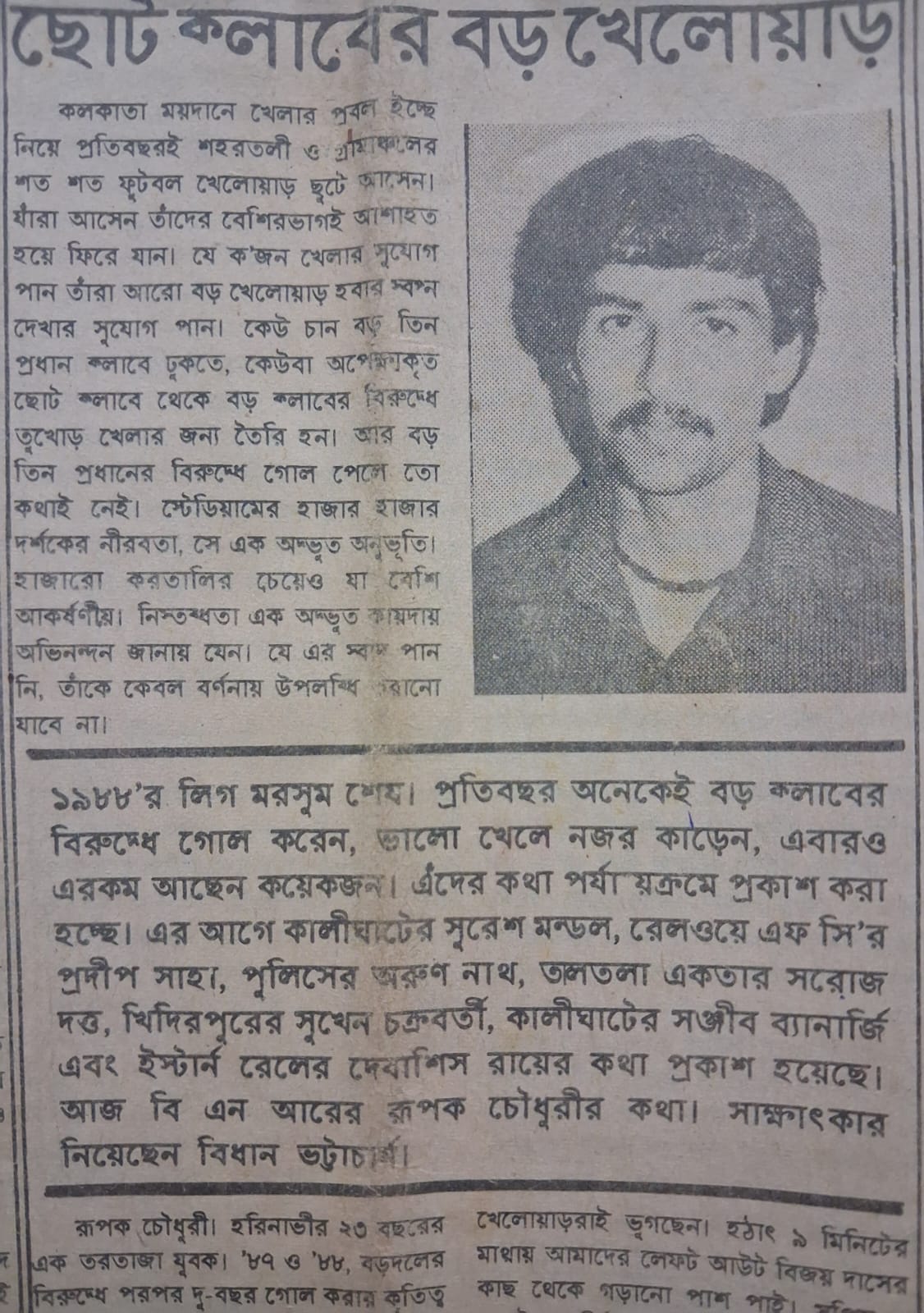
The Untold Story of Footballer Rupak Chowdhury
Rupak Chowdhury is a name that is not unfamiliar in Kolkata football circles. He played extensively for smaller clubs and also earned the opportunity to wear the jerseys of bigger teams. Yet, he was a different kind of footballer. Why different? Because his conduct on the field, his behavior off it, his lifestyle, and his overall personality set him apart from many of his contemporaries.
When people speak of discipline and sportsmanship, Rupak's name often comes up. Interestingly, there is a memorable story behind this transformation.
Rupak emerged from the Baruipur League, representing Harinavi. It is said that during those days he was one of the league's biggest attractions. Fans would travel from faraway places just to watch him play, and his presence alone could increase match attendance by 500 to 1,000 spectators.
However, in his early days, Rupak was much like any other competitive footballer. In the heat of physical contests, he too would occasionally lose his temper. During one particular match, after scoring two goals, he had another legitimate goal disallowed by the referee. Furious at the decision, he argued with the referee and even uttered some harsh words.
What happened afterward changed his life.
According to Rupak, after the match an elderly gentleman called him over. First, the man praised his performance and then said:
"We travel from far away to watch you play football, not to watch you lose your temper or hear you use foul language. Did speaking badly to the referee change his decision?"
Those words struck Rupak deeply. He recalls being profoundly shaken by the encounter. From that day onward, he began working on changing himself. It did not happen overnight, but gradually he transformed both his behavior and his outlook on life.
As a result, Rupak became much more than a football star in Baruipur and the surrounding areas. He evolved into a role model.
Reflecting on this, Rupak says:
"Perhaps that is why people still love me so much today. What greater achievement can there be? I believe that whatever you do in life, it is essential to have the right philosophy. One must be disciplined and self-controlled."
This emphasis on discipline is also why he admired coach Naimuddin so much.
To illustrate his point, Rupak cites an example from cricket. He notes that Sunil Gavaskar, in one of his books, placed cricketers Padmakar Shivalkar and Rajinder Goel alongside some of the greatest legends as his idols. Rupak asks:
"Those two may not have been superstars, but what qualities did they possess that made Gavaskar think so highly of them?"
In that question lies a reflection of Rupak himself—someone who values character as much as achievement.
Even today, he remains committed to social causes. With the support of friends, former teammates, and his own resources, he helps run three NGOs and has taken responsibility for around 240 orphaned children.
His advice to today's footballers is simple:
"Stay away from local money tournaments ('khep' football). Avoid temptations."
Yet he also understands the realities faced by modern players:
"They may have a point. In our time, football could lead to stable employment. Today many players are forced to play in such tournaments simply to support their families. What can one do except feel disappointed?"
Interestingly, Rupak does not blame young footballers for the decline in the emergence of Bengali talent. Instead, he questions why clubs—both big and small—are increasingly prioritizing players from other states. He wonders why so many coaches seem reluctant to place their faith in Bengali footballers.
In conclusion, Rupak says he is content with whatever football has given him. He harbors no complaints against anyone. The fact that people still recognize him and tell him that he was a better footballer than many who became established stars is reward enough for him.
Is there a trace of regret or disappointment within him? Perhaps. But it never shows.
Because that is what makes Rupak Chowdhury special—not just as a footballer, but as a human being. Different. Admirable. A role model worth emulating.