
INDIAN FOOTBALL: THE BRAZIL OF ASIA AND THE LOST ROAD
What Indian football has lacked for generations is not love for the game. It has lacked direction. That is what makes the story of Indian football so fascinating and so painful.
Rahul Mukherjee: Indian football does not have a shortage of passion.
It never did.
Every time Mohun Bagan plays East Bengal, every time thousands of supporters fill the stands in Kolkata, Kochi, Goa, Bengaluru or Manjeri and every time a child chases a worn football across a dusty field after school, that passion reveals itself. It survives in neighbourhood tournaments, in tea-shop arguments, in old newspaper cuttings preserved like family heirlooms and in the unwavering loyalty of supporters who continue to believe despite decades of disappointment.
What Indian football has lacked for generations is not love for the game. It has lacked direction. That is what makes the story of Indian football so fascinating and so painful.
Unlike many nations that romanticize a glorious past, India does not need to invent one. There was a period when India stood among Asia's footballing powers. There was a period when Indian players earned respect across the continent, when victories against leading Asian sides were celebrated as achievements but not regarded as miracles and when the national team carried itself with the confidence of a nation that believed its future in football was limitless.
Today, that era feels almost mythical to younger supporters yet it was real. The trophies were real. The players were real. The success was real.
When India Became a Football Power
The roots of that success stretch back to the years immediately following independence. Football was already deeply embedded in parts of Indian society long before 1947. The great clubs of Kolkata had created traditions that attracted devoted supporters. Hyderabad was producing exceptional teams and players. Goa's football culture continued to flourish. Across several regions, football was more than a sport. It was identity, pride and community.
The world began to notice Indian football at the 1948 London Olympics. Barely a year after independence, India faced France on one of the biggest stages in sport. The image of Indian footballers playing barefoot against a European opponent has since become part of sporting folklore. India lost only 2-1 in a fiercely competitive contest and missed opportunities that might have changed the result. The defeat mattered less than the impression it created. The world discovered that football in India possessed skill, courage and quality.
Only two years later, India found itself in an extraordinary position. The country had qualified for the 1950 FIFA World Cup in Brazil. Even today, that statement surprises many football fans. Popular mythology often claims India withdrew solely because FIFA prohibited barefoot football. The truth is more complex and in many ways, more tragic. Travel costs to South America were enormous. Preparation time was limited. The All India Football Federation (AIFF) preferred to focus on the Olympic Games.
Administrative disagreement over squad selection further complicated matters. The result was that India declined the opportunity. The nation qualified for the World Cup but never played in it. More than seventy years later, that decision remains one of the great "what if" moments in Indian sporting history.
The Man Who Built the "Brazil of Asia"
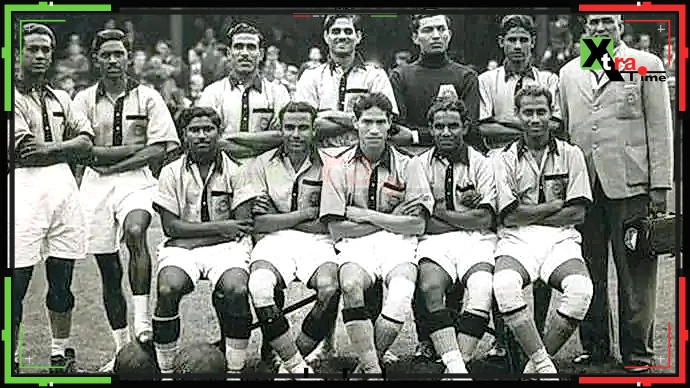
The finest chapter in Indian football history began under the leadership of Syed Abdul Rahim, known affectionately as Rahim Saab. To discuss Indian football's golden age without discussing Rahim would be impossible because he was the architect of everything that followed.
Rahim was not merely a coach preparing teams for matches. He was a visionary who believed that Indian football could compete with the best in Asia through intelligence, discipline and tactical innovation. Rahim was experimenting with tactical systems that emphasized attacking width, positional awareness and coordinated movement, ideas that were ahead of their time in Asian football.
Under his leadership, India developed a style that earned admiration across the continent. The national team became disciplined, technically gifted and difficult to defeat. Over time, a nickname began to follow them wherever they played.
They became known as the "Brazil of Asia," a nickname earned through an attractive attacking style, technical quality and consistent success against some of the continent's strongest teams.
The title was not a product of sentiment or nostalgia. It was earned through performance. India consistently defeated respected opponents and established itself as one of the continent's strongest teams. Long before Brazil made the 4-2-4 formation famous at the 1958 FIFA World Cup, Rahim was experimenting with similar ideas.
The Defeat That Changed Everything
The road to greatness was not without setbacks. One of the most painful arrived at the 1952 Helsinki Olympics when India suffered a humiliating 10-1 defeat against Yugoslavia. The result exposed the growing gap between traditional methods and the demands of modern football. Playing barefoot in harsh European conditions proved a severe disadvantage.
Many coaches might have treated the defeat as an unfortunate result and moved on. Rahim saw it as a lesson. He understood that sentimental attachment to old practices could not replace modernization. Following Helsinki, football boots became mandatory for Indian national team players. More importantly, Indian football began adapting to the realities of international competition.
The response was immediate.
Success followed across major tournaments and India entered the most glorious period in its football history.
The Golden Era
The decade that followed remains unmatched in Indian football. In 1951, India won the inaugural Asian Games football tournament in New Delhi, defeating Iran in the final through a goal from Sahoo Mewalal.
Five years later, the team reached the semi-finals of the Melbourne Olympics and finished fourth, a feat that remains one of the greatest achievements by any Asian football nation of that era. During the tournament, Neville D'Souza became the first Asian footballer to score a hat-trick at the Olympic Games. At the time, very few Asian nations had achieved comparable success on the international stage, further cementing India's place among the continent's footballing elite.
India's rise did not end there. In 1964, the national team finished runners-up at the AFC Asian Cup, recording victories against strong continental opponents and producing what remains India's finest performance in Asia's premier football championship.
These achievements established India among the elite teams of Asia yet the ultimate triumph was still to come.
The 1962 Asian Games in Jakarta remains the single greatest achievement in Indian football history. The circumstances made the victory even more remarkable. Political tensions between India and Indonesia had created a hostile atmosphere throughout the tournament. The final against South Korea was played before nearly 100,000 spectators, many of whom openly supported the opposition. Standing on the touchline was Rahim Saab, already battling terminal lung cancer.
Against those odds, India produced a performance for the ages. Goals from P.K. Banerjee and Jarnail Singh secured a famous 2-1 victory and delivered the Asian Games gold medal. On that day, Indian football stood at the summit of Asia.
Nine months later, Rahim passed away.
In many ways, Indian football lost more than a coach. It lost its guiding force.
The Moment Asia Changed
When football fans remember India's golden era, context is important. During the 1950s and early 1960s, Asian football looked very different from what it does today. The Asian Football Confederation had only a handful of active members. Many Gulf nations that now dominate regional football had not yet developed serious football structures. Japan had no professional league and relied heavily on university players. Australia competed in Oceania and were taking baby steps in football. Iran had yet to emerge as a continental giant.
India's success was genuine and deserved yet it was achieved in a football landscape that was still developing. The difference was that while other nations were beginning their journeys, India believed it had already arrived.
That assumption would prove costly.
When the Rest of Asia Moved Forward
Following a bronze medal at the 1970 Asian Games, won after defeating Japan 1-0, Indian football slowly entered decline.
The decline was not caused by a lack of talent. It was caused by a lack of vision.
While Japan invested in long-term planning, South Korea strengthened school and university pathways and emerging Gulf nations poured resources into facilities and player development, India failed to modernize. Domestic football remained dependent on cup competitions such as the Durand Cup, IFA Shield, Rovers Cup and Santosh Trophy. A proper national league did not arrive until 1996 with the launch of the National Football League.
Most clubs functioned as extensions of banks, railways, police departments and public institutions. Players were employees first and athletes second. Youth academies were rare. Professional coaching structures remained underdeveloped. Sports science barely existed within the football ecosystem.
Perhaps most damaging was India's prolonged absence from FIFA World Cup qualification campaigns between 1954 and 1982. While rival nations gained valuable international experience, India withdrew into isolation. The rest of Asia accelerated. India stood still.
The missed opportunities extended beyond infrastructure. International exposure, regular competitive fixtures and long-term planning were often treated as secondary concerns, allowing rival nations to widen the gap year after year.
History delivered a predictable outcome. Japan launched the J-League in 1993 and built its famous "100-Year Vision." South Korea developed one of the strongest football systems in Asia. Both countries became regular World Cup participants.
The nation once called the "Brazil of Asia" was no longer among Asia's elite.
The ISL Promise and the Modern Crisis
The launch of the Indian Super League in 2014 appeared to signal a fresh beginning. The league brought professional television broadcasts, foreign stars, corporate investment and renewed public interest. For the first time in decades, Indian football felt relevant in mainstream sporting conversations.
Beneath the excitement, structural problems persisted.
The league operated through a franchise model that required clubs to pay substantial annual participation fees. Revenue from broadcasting and sponsorship often failed to offset these expenses. Many clubs accumulated heavy losses and remained dependent on wealthy owners. Instead of building self-sustaining football institutions, many franchises survived through financial support from parent companies.
Recent conflicts between clubs, commercial partners and the AIFF have exposed these weaknesses. Governance disputes, financial uncertainty, declining media value, unpaid wages, transfer bans and even club withdrawals have highlighted how fragile the ecosystem remains.
The problem is not merely sporting. It is structural.
The Kolkata Derby and the Great Contradiction
Nothing captures Indian football's potential and frustration better than the Kolkata Derby.
Mohun Bagan versus East Bengal is one of the oldest and most passionate rivalries in world sport. It reflects history, migration, identity and culture. In 1997, more than 131,000 spectators attended a Federation Cup semi-final between the two clubs. Even by global standards, it was a staggering figure.
This rivalry also reveals Indian football's greatest weakness. Despite extraordinary support, Indian football struggles to convert passion into sustainable revenue. European clubs generate enormous income through stadium ownership, hospitality, merchandise and commercial partnerships. Indian clubs often play in government-owned stadiums, earn limited matchday revenue and lose merchandise sales to counterfeit markets.
The problem extends beyond revenue. The matchday experience in India often fails to make supporters feel part of a larger spectacle. Many stadiums lack comfortable seating, clean facilities, quality food options, efficient entry systems and fan engagement zones. In leading football nations, a match is a day-long celebration that attracts families, casual spectators and even non-football fans. In India, supporters often come because they love their club, not because the venue offers a memorable experience. Creating better matchday environments is essential if clubs want to turn occasional visitors into lifelong supporters.
The audience exists. The passion exists. The business model often does not.
The Road Back
The biggest myth in Indian football is that the country lacks talent. History disproves that claim.
From P.K. Banerjee, Chuni Goswami, Jarnail Singh and Neville D'Souza to Bhaichung Bhutia, I.M. Vijayan and Sunil Chhetri, India has consistently produced exceptional footballers. In the modern era, Chhetri became the face of Indian football, carrying the national team for nearly two decades and establishing himself among the highest international goal scorers in the history of the game.
The real problem has never been talent. The real problem has been systems.
Indian football needs governance that is transparent and stable. Clubs must invest in academies instead of short-term success. School and university football must also become stronger because sustainable success begins with broad participation at the grassroots level. Every successful football nation builds a pathway that allows young players to progress from local competitions to professional football.
Participation fees should be replaced with investments in infrastructure and youth development. Revenue-sharing models must become fairer. Professional clubs need greater control over stadiums so they can generate sustainable income. Above all, India requires a long-term football vision similar to the blueprint that transformed Japan.
The Final Whistle
The story of Indian football is often described as a story of decline. That description is incomplete. It is more accurately a story of divergence.
While others planned for the future, India relied upon tradition. While others built systems, India trusted memories. While others transformed football into a modern ecosystem, India remained attached to structures that belonged to another era.
History provides a reason for hope.
A country that once conquered Asia still possesses passionate supporters, historic clubs, football-loving communities and millions of young players dreaming of something bigger. The golden era matters not because it allows us to relive old victories. It matters because it proves what Indian football can become when vision is matched by leadership.
The question is no longer whether India was once the "Brazil of Asia."
The question is whether Indian football has the courage, patience and wisdom to become great again.