
Fear 0, Confidence 10: A new era for Indian football began at the Yuva Bharati on Saturday
Economics has a theory called the Big Push Theory. When a country's economy gets trapped in a cycle of poverty, it can remain there for years. Low income leads to low investment. The entire economy becomes trapped in a vicious cycle. To escape, a “big push” is required.
Anilava Chattopadhyay
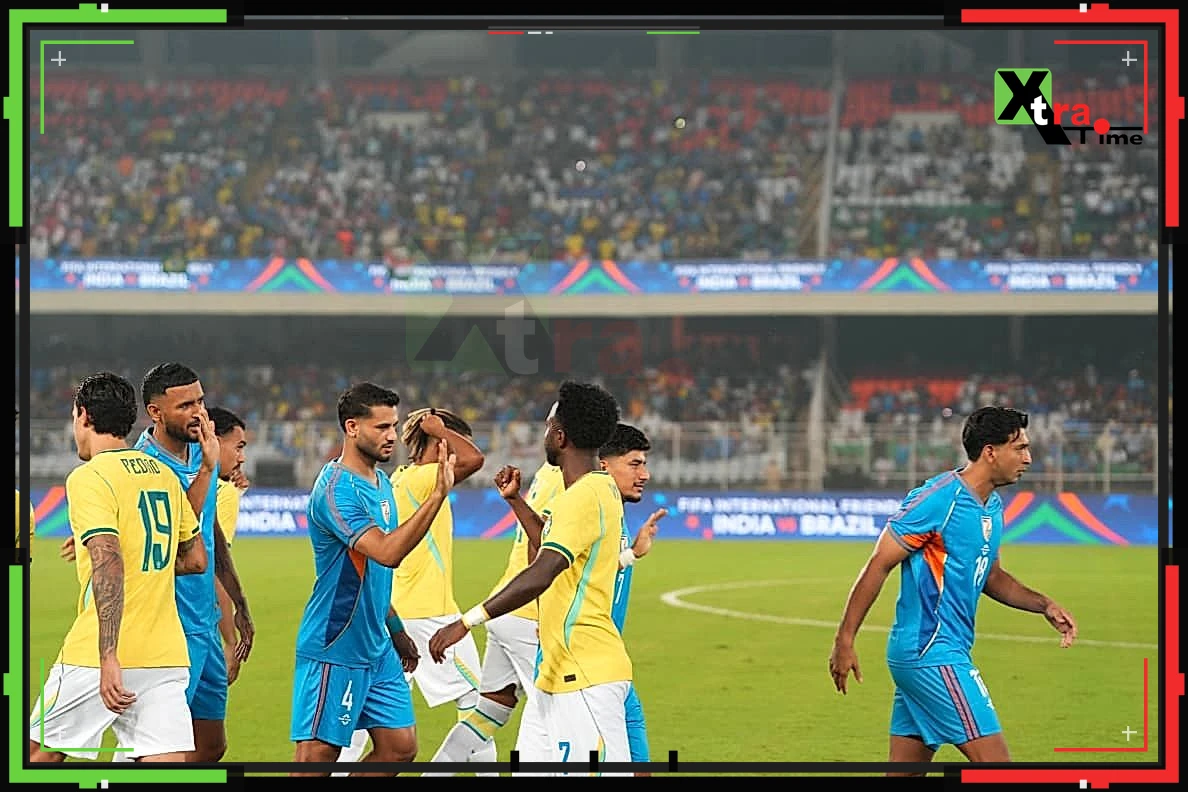
Brazil 4 India 0
Courage 10 Fear 0
You can read the scoreboard this way too.
What India’s football team gave Indian football in those 97 minutes at the Salt Lake Stadium on October 3, 2026, may well be something the sport in this country has failed to give us in 125 years.
There have been many heroic chapters in Indian football. Many heroes have given us proud moments. But the arch of courage that these 22 Indian players built today had never been seen before.
Because we simply never played like this.
We never played at this level. We never really understood what it takes to compete at this level of football.
Yes, India lost 4-0. Four-nil. But the result could easily have looked different. What if Gurpreet had been just a little better? What if Brazil had not produced that goal-line clearance to deny Ryan Williams?
What if it had ended 2-1?
We have written about such “what ifs” many times before. We have carried the pain of defeats despite good performances. Our cupboards are filled with trophies, cups and shields from matches in which we played well but still lost.
But those opponents were not Brazil.
São Paulo, Bochum, Eindhoven, Bayern Munich, Japan at the Asian level—so many names come to mind. But so do the memories of helpless surrender.
You may be disappointed by a four-goal defeat. But honestly, tell me—did you not fear, even once, that this could turn into another embarrassing night?
Before the match, didn’t someone among your friends or relatives say: “India are playing Brazil? How many will they concede?”
People had criticised Kalyan Chaubey, saying India should first play Bangladesh.
Yet at the end of the match, many of those same people were saying: “If only those two first-half goals had not gone in!”
Yes, there was disappointment today.
But there was no shame.
There was a 4-0 defeat, but there was no surrender. There was a team willing to look Brazil in the eye and fight.
India had eight players defending at times, but six or seven were also pushing forward on the counter, increasing their numbers in Brazil’s defensive third. They pressed Brazil in the opposition middle third at every opportunity.
Who were these players?
Where was the familiar sight of 11 Indians standing inside their own box, desperately trying only to reduce the margin of defeat?
This was a new India.
A new India in football.
There are so many people who dream about Indian football. So many people who put extraordinary effort into keeping the sport alive.
Perhaps an unknown coach in a forgotten village in Kerala gives his entire life to the dream of producing one footballer.
Perhaps a woman coach in the Junglemahal region, wearing a sari, spends every morning and evening working with young players while sacrificing time with her own children.
Perhaps a familiar Haruda, Debuda or Shivuda from a small town in Bengal spends his entire life begging for money so that the local annual football tournament does not disappear.
Perhaps the boy in a fan club saves a little money from his lunch every day to make a tifo.
These are not “perhaps”.
All of it is real.
Indian football survives because of this passion.
A country ranked 138th in the world continues to play football because of these people and this passion.
Everyone is fighting for it.
If Ranjit Bajaj is fighting in Punjab, our grassroots coaches Ranjan Choudhury and Amiya Ghosh are fighting too.
Baichung is fighting. Ancheri and Barreto are fighting.
Debjit Ghosh and Pallab Basu Mallik fight from the commentary box. Marcus and Saif fight from the press box.
Goenka’s team fights from its Alipore office. The Durand Committee and Cherry Tree fight from Army offices.
In Kolkata’s Sutar Kin Street, Anirban Dutta and others spend the year finding financial support for Bengal football. In Delhi’s Dwarka, the federation is fighting too.
In a country of 1.4 billion people, they do not have the financial strength or manpower required to run football the way they would like.
What they have is passion.
But when financial limitations remain hidden behind passion for years, something else gets damaged.
Confidence.
And like an infection, the lack of confidence slowly destroys courage.
It reduces the courage of administrators, employees and eventually footballers themselves.
It is easy to label someone. But how often do we actually examine what happened before and after?
Amiya Ghosh, who played in the final of the Dana Cup three decades ago, now spends much of his time sitting at home.
A Mayor’s XI that returned as champions receives little attention.
Jayanta Sen, who earned a place in an All-Star XI, is forgotten.
But Ranjit Bajaj wins the same tournament and suddenly creates a storm across Indian football.
Why?
Because he has money. He has media access. Through Minerva Academy, he also has administrative connections.
That allows him to repeatedly attack and embarrass Indian football administration while the federation remains silent.
It remains silent even when an Indian commercial company wants to swallow him up, trying to buy him cheaply.
Wrong narratives are created.
The federation lacks money.
The federation lacks courage.
Kalyan Chaubey, M. Satyanarayan, and Akshay Rohatgi were trying to create that courage in a different way.
The very idea of bringing five-time world champions Brazil to play India was courageous.
One bad, humiliating result could have destroyed everything.
And then there was the enormous financial risk.
The obvious counterargument was ready:
Why spend this money? Several academies could have been built with it.
Wrong.
Look at the money coming in now. Look at the corporate sponsors stepping forward.
They are doing it because Brazil came.
Go to these companies asking them to fund football academies and see how many are willing to give you a rupee.
In today's mobile-driven world, everyone is empowered enough to criticise everyone. We cut down kings and ministers every day from behind our phones.
Try launching a crowdfunding campaign to build a football academy for children.
See how many people actually contribute.
Yet the same people are willing to pay ₹6,000 for a ticket to enter Salt Lake Stadium.
Why?
Because the team on the other side is Brazil.
Believe me, Indian football needs that person who spends ₹6,000 or ₹15,000 on a ticket.
Indian football also needs the bureaucrats and ministers who came to the stadium in large numbers because Brazil had arrived.
They too went home carrying something important:
The belief that football can be trusted.
That Manvir, Abhishek and Anwar can be trusted.
That Kalyan Chaubey, Anirban Dutta, Debashis-Srinjoy, Debabrata Sarkar and the Nawabs can be trusted.
They are removing the fear.
Now we need to add one more thing:
Trust.
Economics has a theory called the Big Push Theory.
When a country's economy gets trapped in a cycle of poverty, it can remain there for years.
Low income leads to low investment. The entire economy becomes trapped in a vicious cycle.
To escape, a “big push” is required.
Investment and the flow of money have to increase dramatically to break the trap.
The Brazil match was that Big Push for Indian football.
If the follow-up programme continues, Indian football can change.
Because yesterday, Manvir and the others did more than understand something themselves.
They showed the entire football ecosystem—supporters, sponsors and stakeholders—that India can still play on this stage.
We did not have a Kalyan Chaubey who was willing to take all the abuse and criticism and still have the courage to arrange matches against Brazil, Uruguay and Panama.
And now there is one.
Apparently, Brazil did not play with full intensity.
Of course, that debate has already started. How could it not in Bengal?
A team that was still attacking Brazil's box in the 94th minute, desperately searching for another goal, apparently “wasn't taking the match seriously”.
Come on.
Let's at least give people what they deserve.
The same person who discussed on the phone in the morning how many goals India would concede is now saying Brazil should have scored another one.
And yes, a FIFA friendly is not really “friendly”.
Look at some recent big-margin wins in FIFA friendlies.
Panama 6-2.
Croatia 3-1.
South Korea 5-0.
Tunisia 5-1.
India 0-4.
They all play at the World Cup.
We organise FIFA friendlies and immediately start worrying that everything is going to collapse.
What a strange world.
Yesterday, standing in the stands, I felt deeply emotional.
I have covered three World Cups.
And I always felt like an outsider.
I sat in media centres representing a country whose identity often prompted journalists from other nations to ask:
“India? What are you doing here?”
How many times have I answered that question?
At press conferences, we were almost always the last priority.
I have spent countless hours interviewing Brazilian journalists and writing about their team's glory.
We never had much access of our own.
But yesterday, our country played against them.
All the way until the final whistle.
I kept looking at the scoreboard.
At 27 minutes and 53 seconds, it still read:
Brazil 0, India 0.
I was reading it differently.
Fear 0. Trust 10.
That trust is courage.
Khalid Jamil's courage.
Kalyan Chaubey's courage.
Please don't deny it.
You have criticised them enough.
I remember another man whose eyes reflected this courage when I travelled to the ASEAN Cup in 2003.
I am certain Bhowmik-da would have been delighted to see yesterday.
Subhash Bhowmik used to say, “I was the one who ruined that momentum.”
But that ASEAN Cup involved Thailand, the Philippines and Indonesia.
This was a different litmus test.
Indian football had never taken this test before.
Please don't let this momentum disappear again.
And when Argentina comes to play a FIFA friendly, don't suddenly show your teeth and claws and jump at them as if the entire future of Indian football depends on winning that one match.
I am thinking of journalist Manas Chakraborty.
Manas-da had one great dream.
The day India qualified for the World Cup, he wanted to carry the Indian tricolour to the centre circle and plant it there.
That's what dreams are.
Manas-da returned to the dressing room without seeing that dream fulfilled.
So did so many others.
They watched their deepest dreams die before they did.
Some are still alive.
Some still run clubs with their own money.
Some still buy boots with their own money for poor children in their neighbourhood.
I don't know why, but I have a feeling their dreams will come true this time.
I don't know how long it will take.
I don't know whether we will still be here when that day arrives.
But Indian football will not remain unnoticed for another hundred years.
It cannot.
That is why the Brazil match was necessary.
Very necessary.


